Showing posts with label Tips. Show all posts

Monday, 30 April 2012

TIP - Removing stains from vessels

You don't have to muscle hard to remove burnt stains from your pots/pans. Just follow this tip and you are good to go :)

I have tried this to remove burnt marks from stainless steel utensils, remove the water marks from brass vessel. Works like a charm. You can also do the same to clean the inside of your pressure cooker.

Steel idly cooker free from really black burnt stains and now shining new

Brass vessel which had water stains and nickel like deposits now clean like new one

To the pot/pan add about 2tbsp citric acid crystals. Fill water for about 3 inches and boil for about 10 minutes. Drain the water and clean with your usual dishwashing liquid/soap. You'll see that the stains have vanished and the vessel is shining like new one :)

Courtesy: Sanjeev Kapoor Khazana

Wednesday, 28 July 2010

MICROWAVE TIPS 2

I'm giving few tips for cooking in Microwave.These are tried and tested and have been updated here. I've not checked the coconut shell tip alone.

  • Always give the dishes a minimum standing time of 2 minutes before removing from the oven.
  • Boiling milk - To boil 1 litre milk, cook on full power for about 7-8 minutes. Then cook on 60% power for 5 minutes. Do not close the dish when boiling milk. Initially when boiling, keep the timings lesser than mentioned and try increasing by 30seconds or 1 minute till you find the right time else milk can boil over.
  • Melting chocolate - Chocolate can be melted in microwave avoiding the double boiler. Microwave on 50% for about 2-3 minutes.
  • The skin of garlic pods are easier to peel when microwaved for 30 seconds.
  • Before squeezing lemons, microwave them for a minute. The juice is easily squeezed.
  • Similarly, warming oranges for a minute would yield more juice.
  • When making recipes with milk, use deep bottomed vessels to avoid boiling over.
  • Tur dal is best cooked in pressure cooker. Other dals can be cooked in microwave. Before microwaving, soak in hot water for 30minutes outside and then microwave until cooked.
  • To remove the coconut from its shell, microwave it for 3-4 minutes.
  • Glass jars can be sterilized in microwave before using them to store pickles, curry leaves etc.
  • Roasting peanuts - Place peanuts in a small bowl and microwave for a minute and slowly increase the time by 30seconds periodically checking on them. If left for a longer cooking time, peanuts can get charred and the odor would be difficult to get rid of and even your neighbours would know that you've burnt something. ;-)
  • Re-crisping biscuits - Have the biscuits gotten soft. Its simple to get them back to crisp state. In a paper towel, place the biscuits and microwave for a minute.

Cooking Rice - Rice can be cooked in microwave. If rice is used directly without soaking, the time taken is more. For example, a small cup of rice would take 10-12 minutes on full power and another 8 minutes on 50% power. Again the timing is to be increased if the rice is not cooked.

The rice cooked in microwave is best used for pulaos, biryanis, all variety rices where we want the grains separate and not sticky.

To shorten the cooking time, soak the rice in hot water for about 20-30mins outside and then microwave.

Do not put all the water necessary for rice at once. This can lead to overflowing of the water when the rice is boiling. Add half the required quantity at first and the rest when almost no water is left. Or use a large bowl with all the required quantity of water at once.


Steaming, Cooking vegetables
-Any vegetable can be steamed in a oven. There are a couple of things to keep in mind.
  • Its very important that you cut all the pieces of approximately the same size. This will ensure even cooking.
  • When cooking / steaming, stir once in 2-3 minutes. This will ensure the vegetable getting cooked evenly from all sides.
  • Never pile food one on top of other.
  • When cooking an assortment of veggies, keep the hard veggies at the bottom and tender ones at the top. This will ensure that all the vegetables get cooked at the same time and none is over-cooked or under-cooked.
  • When boiling whole potatoes, make few pricks with fork and place over the glass table. Note here that we are placing it directly on the glass plate of the oven. Cook for 6-7 minutes. its important to make pricks to avoid bursting of whole potatoes. This applies to big brinjals as well.
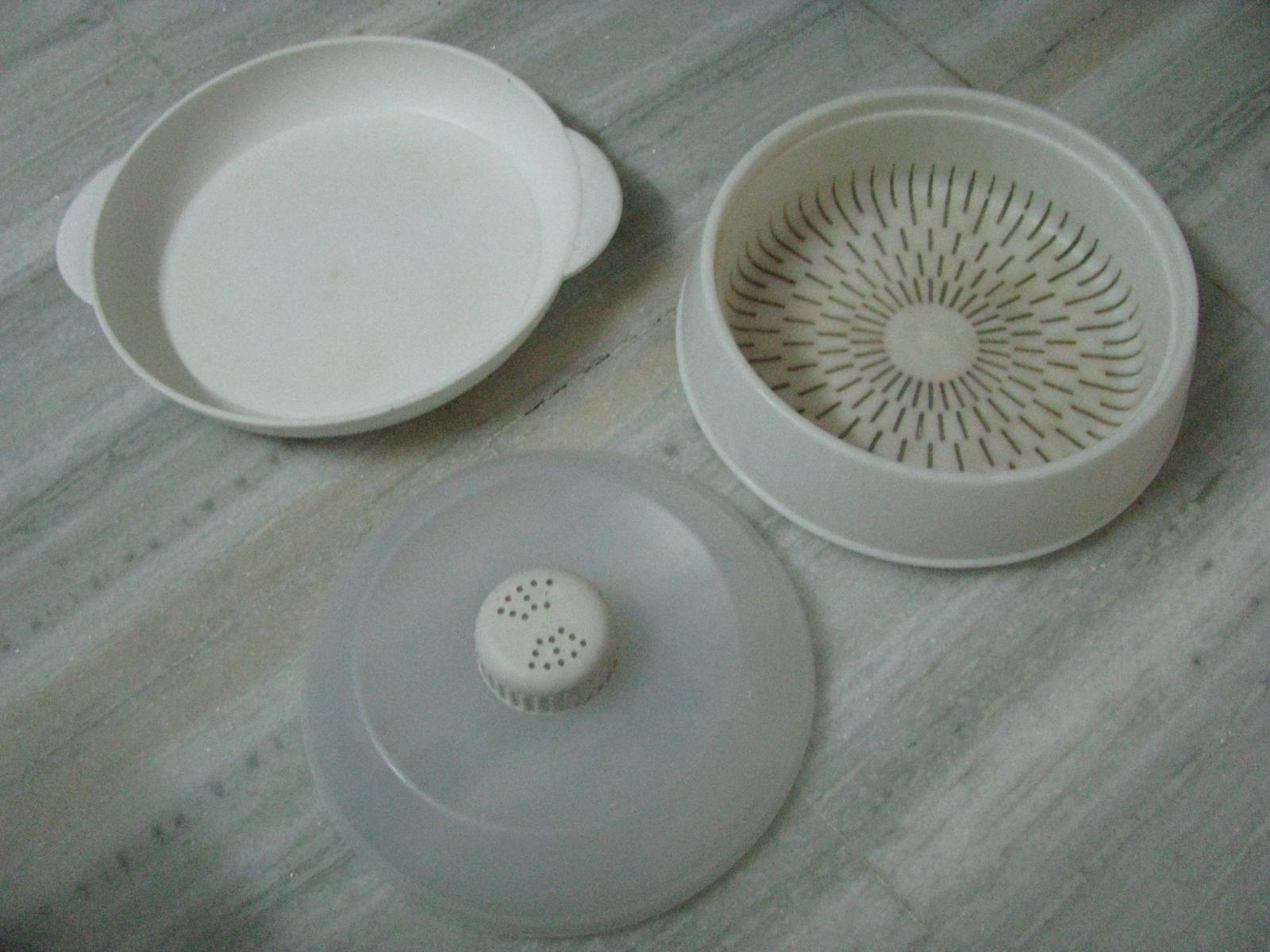
  • Here's a pic of the vegetable steamer that am currently using. The one on the left is the bottom most which would hold water. The 2nd dish is the one that would sit on top of the water holding container. The veggies would be placed in this. This will be covered with a lid that has adjustable vents for the steam to escape.

  • Steaming veggies - Cook on high power for 5 minutes. Then cook on 50-60% power for another 3 minutes. This way the veggies get cooked well. If the veggies are not cooked still, increase the cooking time. This varies with each veggie.
  • Extracting tamarind juice - For making rasam, sambar, if you do not have tamarind paste at hand, this tip would work the best. In a small bowl, put the required amount of tamarind with little water and put in microwave for 1-1.5 minutes. The tamarind would tenderize and extracting juice is just kids play.
  • I've found that when tomatoes are cooked and pureed and used in gravies, rasam, sambar, the dish taste awesome. For this place cut tomatoes in a small bowl with little water and cook for 4 minutes. Blend and use.

Preparing instant coffee or tea -
  • To make instant coffee directly in a glass (best when making for 1-2 persons) -Place milk in a microwave safe glass and microwave for a minute. Keep a watch since milk can boil over. Add instant coffee powder, sugar. Stir well and put it back into the oven for another 30 seconds.
  • For tea, place tea leaves with required water in a microwave safe pot and microwave for a couple of minutes.

Reheating Food -
Most people use microwave for reheating purposes. Here are few tips for reheating food.
  • Reheat idlies by sprinkling very little water over then and cover with a cling film.
  • Reheat rice by covering with a cling film and make small incisions on the film for the steam to escape. You may even reheat without a cling film.
  • Never cover dishes with lids while reheating for more than a minute in a microwave safe plastic dishes.
  • Other foods may be simply reheated without covering the dishes even with cling film.
  • UPDATED (30 Aug 2011) - Reheat chapathis in a closed microwave safe container for a minute. If reheated in open, the chapathis would get harder once they cool down. By reheating in a closed container, the moisture from chapathis is retained and even when little cooled down would remain soft.

Tuesday, 27 July 2010

MICROWAVE TIPS - 1

Initially when I had purchased my oven, I was wondering how to use it more effectively. I googled and found few. I started using it regularly for my cooking. Microwave has definitely made my life easier. :)

As you might know, in MICROWAVE MODE we cannot use steel, aluminium utensils (even spoon) in the microwave when cooking. It would lead to the creation of sparks. When in CONVECTION MODE , one may use aluminium tray for baking. I've never used GRILL MODE so am not in a good position to give tips on that.

One can use microwave safe plastic bowls, ceramic bowls, glass bowls for cooking. Its best to use the microwave safe plastic bowls for reheating purposes rather than for cooking. Use glass or ceramic bowls for cooking.

There are a few things that you would need to buy apart from the starter kit provided. Few of them would be a vegetable steaming basket, pot for boiling milk, few microwave safe bowls. Also you may need a single or a pair of gloves to remove the dishes from the oven, tissue box and a cling film.

My oven's output is 750W. The cooking time mentioned would vary for different outputs. Adjust accordingly.

I have categorized the tips into general tips and cooking tips.

General Tips
  • Read the manual provided thoroughly before starting to use your oven.
  • Do not keep the oven too close to the wall. Allow atleast a feet from the wall.
  • Do not close the vents of the oven.
  • Do not cover the oven with oven cover while cooking. Once the oven has cooled down, you may cover the oven.
  • Get a cling film roll. You can use the cling film to cover the dishes while cooking foods that have no or very little water. This will help the food to cook faster, retain the moisture and tenderize it. Not all cling films are microwave safe. So look for microwave safe and food grade cling films.
  • If you are not comfortable with cling films, you could use a special microwave safe lid for covering dishes. These are lids have few vents for the steam to escape.
  • Have your glove handy. Fix it near the microwave. I've put mine to a hook fixed to the side of the fridge next to the oven.
  • Have a tissue box near the microwave always. Whenever there are spills, you can wipe them off right away, saving your time in cleaning the microwave glass plate. I've just put the tissue box over the vent to take a pic. Never close the vent. :)
  • To remove bad odor from the oven, place a small bowl with a cut lemon and little water in the oven and cook for 2 minutes. The odor would vanish. :)
  • You can have a tissue paper placed over the glass plate to avoid messing the glass plate from spills.
  • Clean your oven interiors with a mix of vinegar (1 tbsp), water (1 tbsp) and a 1 tsp of baking soda. It'll leave your oven sparkling.

Wednesday, 26 May 2010

How to blanch vegetables

Blanching is a technique which is used to keep the vegetables crisp and tender. This process helps kill the bacteria in the vegetables. Blanching helps preserve the color and flavour of the vegetables. In this process, the vegetables are put in hot boiling water for a couple of minutes and then immediately transferred to ice cold water.

In the following article, I'm gonna explain blanching of tomatoes in specific.

Tomato is one of the most common vegetables that is blanched. The blanched tomato can be used to make sauce or ketchup.

Friday, 21 May 2010

Egg substitute

The egg in the cake does add to the fluffiness and the eggless cakes some what lack there. So why not give your cakes the same fluffiness without adding eggs but using egg substitutes?

One substitute which I commonly found while googling was the FLAXSEED. Flaxseed is also known as Linseed. It is called 'Avise Ginjalu' in Telugu, 'Ali Vidai' in Tamil, 'Alsi' in Hindi. I hunted for it big time at Big Bazaar, Spencer's Hyper but failed. I finally bought it when I made a trip to Chennai. I found it easily at Nilgiris. You can also find flaxseed in 'Nuts and Spices' outlet and there is one in Hyderabad too.

To substitute 1 egg, add 3 tbsp warm water to 1 tbsp flaxseed powder (in stores you get flaxseed in the powder form) and let it stand for 10 minutes. After 10 minutes you would find that it gets quite the same texture as that of an egg. It serves the binding purpose that the eggs are used for in the cakes. These days most people are using flaxseed instead of eggs for its health benefits and for the lower calories as compared to eggs.

Flaxseed can also be used in soups. Checkout my Tomato Oats soup recipe for the same.

Thursday, 20 May 2010

Making tamarind paste at home

Life and cooking gets simpler when we have things planned out. One ingredient which we south indians use mostly on a daily basis is tamarind for making rasam, sambar, kuzhambu etc. Soaking the tamarind to extract the juice is sometimes boring. And there can be times when we suddenly decide to make rasam but we need to soak tamarind then and there. So one simple way is to have your tamarind paste ready at hand.

This paste can be stored in the fridge for 2-3 months. I googled for the procedure and combined two methods after quite experimenting and arrived at this recipe. I make this and store in a bigger air-tight container in the fridge and have a small container to take and use it.

Ingredients
  • Tamarind - 500gms
  • Turmeric - 1 tsp
  • Salt - 1/2 cup (standard measuring cup)
  • Oil - 150 ml ( would make upto 1/3 of a standard measuring cup)
  • Fenugreek / Methi seeds / Vendayam / Menthulu - 2 tbsp

Procedure
  • Remove seeds and threads as far as possible from tamarind.
  • In a pressure pan, add the tamarind. Pour water such that tamarind gets immersed.
  • Add salt, turmeric. Cook for 2 whistles.
  • Open the lid after 1-2 hours.
  • If you find threads or seeds remaining remove them now.
  • Meanwhile, dry roast the fenugreek and powder in a mixer.
  • In a pan, add oil and once hot add the tamarind paste, fenugreek powder.
  • Stir it once in a while and cook it till its quite a thick paste like sauce.
  • Cool and store it in a air-tight container in fridge.
Things to remember
  • Since you've already added salt to this paste, take care while adding salt to your recipe.
  • To make sambar for 3-4 persons, you can use 2 tsps of paste.
  • Always use a dry spoon or have a spoon in your small container and take care not to have water into it.
  • Since this paste is already cooked, your gravies need not be cooked for a longer time. We generally cook gravies for a little longer time after adding tamarind to eliminate the raw smell and taste. Here that is not required.

Sunday, 25 April 2010

Tip to store curry leaves

Here's a simple tip to store your curry leaves fresh for weeks....


As soon as you get the leaves from the market, separate the leave from the stem. Wash them and dry them under the fan until there is no moisture content. Store the leaves in a GLASS JAR. Your leaves stay fresh for weeks :)


Try it to believe it. :)
Get widget

You might also like...

Related Posts Plugin for WordPress, Blogger...